



Deskripsi
Introduction
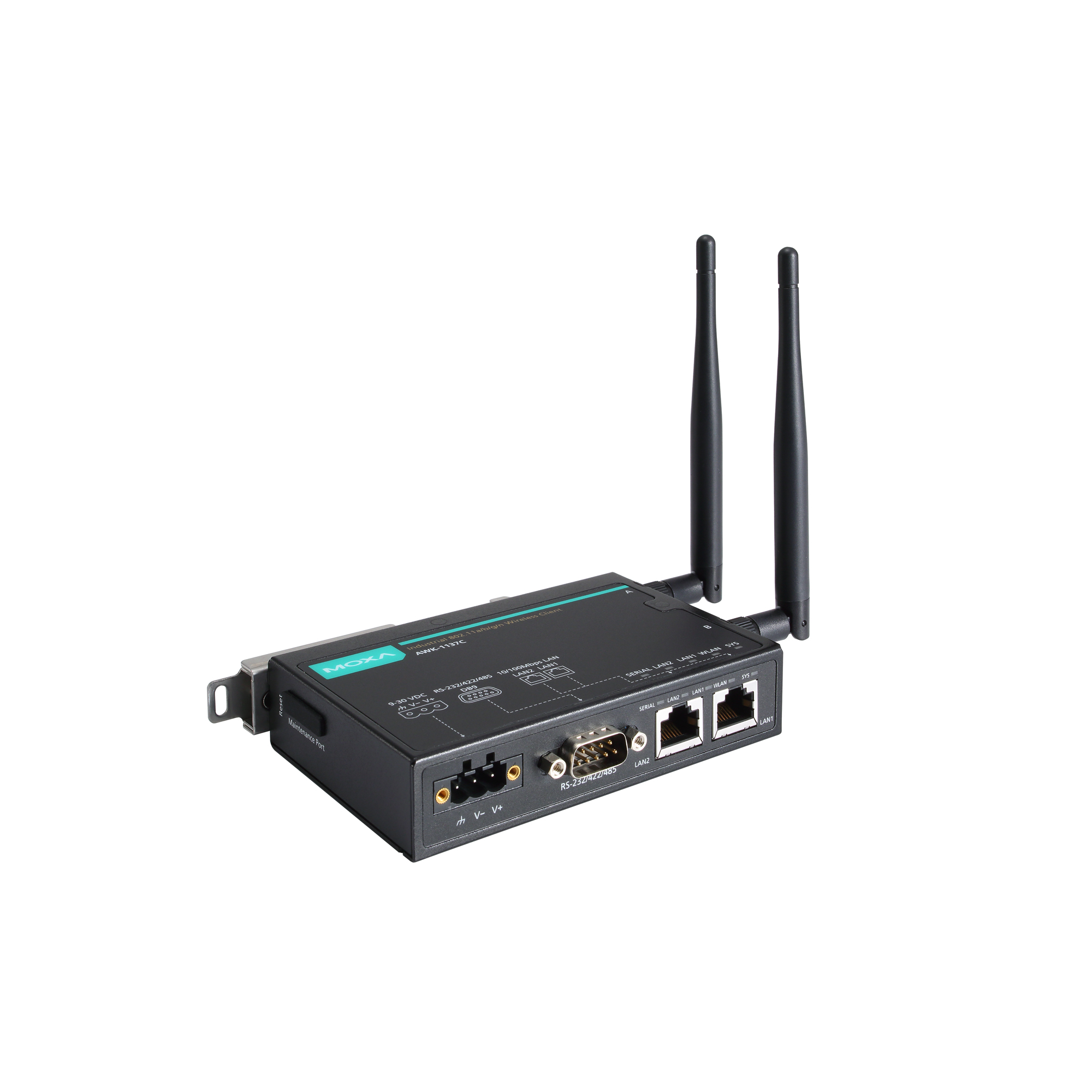
The AWK-1137C is an ideal client solution for industrial wireless mobile applications. It enables WLAN connections for both Ethernet and serial devices, and is compliant with industrial standards and approvals covering operating temperature, power input voltage, surge, ESD, and vibration. The AWK-1137C can operate on either the 2.4 or 5 GHz bands, and is backwards-compatible with existing 802.11a/b/g deployments to future-proof your wireless investments.
Highlights
WLAN Standards
802.11a/b/g/n
802.11i Wireless Security
Modulation Type
DSSS
OFDM
MIMO-OFDM
Frequency Band for US (20 MHz operating channels)
2.412 to 2.462 GHz (11 channels)
5.180 to 5.240 GHz (4 channels)
5.260 to 5.320 GHz (4 channels) DFS (Dynamic Frequency Selection) channel support: In AP mode, when a radar signal is detected, the device will automatically switch to another channel. However, according to regulations, after switching channels, a 60-second availability check period is required before starting the service.
5.500 to 5.700 GHz (11 channels) DFS (Dynamic Frequency Selection) channel support: In AP mode, when a radar signal is detected, the device will automatically switch to another channel. However, according to regulations, after switching channels, a 60-second availability check period is required before starting the service.
5.745 to 5.825 GHz (5 channels)
Frequency Band for EU (20 MHz operating channels)
2.412 to 2.472 GHz (13 channels)
5.180 to 5.240 GHz (4 channels)
5.260 to 5.320 GHz (4 channels) DFS (Dynamic Frequency Selection) channel support: In AP mode, when a radar signal is detected, the device will automatically switch to another channel. However, according to regulations, after switching channels, a 60-second availability check period is required before starting the service.
5.500 to 5.700 GHz (11 channels) DFS (Dynamic Frequency Selection) channel support: In AP mode, when a radar signal is detected, the device will automatically switch to another channel. However, according to regulations, after switching channels, a 60-second availability check period is required before starting the service.
Frequency Band for JP (20 MHz operating channels)
2.412 to 2.484 GHz (14 channels)
5.180 to 5.240 GHz (4 channels)
5.260 to 5.320 GHz (4 channels) DFS (Dynamic Frequency Selection) channel support: In AP mode, when a radar signal is detected, the device will automatically switch to another channel. However, according to regulations, after switching channels, a 60-second availability check period is required before starting the service.
5.500 to 5.700 GHz (11 channels) DFS (Dynamic Frequency Selection) channel support: In AP mode, when a radar signal is detected, the device will automatically switch to another channel. However, according to regulations, after switching channels, a 60-second availability check period is required before starting the service.
Wireless Security
WEP encryption (64-bit and 128-bit)
WPA/WPA2-Enterprise (IEEE 802.1X/RADIUS, TKIP, AES)
WPA/WPA2-Personal
Transmission Rate
802.11b: 1 to 11 Mbps
802.11a/g: 6 to 54 Mbps
802.11n: 6.5 to 300 Mbps
Transmitter Power for 802.11a
23±1.5 dBm @ 6 to 24 Mbps
21±1.5 dBm @ 36 Mbps
20±1.5 dBm @ 48 Mbps
18±1.5 dBm @ 54 Mbps
Transmitter Power for 802.11n (5 GHz)
23±1.5 dBm @ MCS0/8 20 MHz
18±1.5 dBm @ MCS7/15 20 MHz
23±1.5 dBm @ MCS0/8 40 MHz
18±1.5 dBm @ MCS7/15 40 MHz
Transmitter Power for 802.11b
26±1.5 dBm @ 1 Mbps
26±1.5 dBm @ 2 Mbps
26±1.5 dBm @ 5.5 Mbps
25±1.5 dBm @ 11 Mbps
Transmitter Power for 802.11g
23±1.5 dBm @ 6 to 24 Mbps
22±1.5 dBm @ 36 Mbps
20±1.5 dBm @ 48 Mbps
19±1.5 dBm @ 54 Mbps
Transmitter Power for 802.11n (2.4 GHz)
23±1.5 dBm @ MCS0/8 20 MHz
17±1.5 dBm @ MCS7/15 20 MHz
23±1.5 dBm @ MCS0/8 40 MHz
17±1.5 dBm @ MCS7/15 40 MHz
Transmitter Power
Transmitter Power
Read more
Receiver Sensitivity for 802.11a (measured at 5.680 GHz)
Typ. -90 @ 6 Mbps
Typ. -88 @ 9 Mbps
Typ. -87 @ 12 Mbps
Typ. -85 @ 18 Mbps
Typ. -81 @ 24 Mbps
Typ. -78 @ 36 Mbps
Typ. -74 @ 48 Mbps
Typ. -73 @ 54 Mbps
Note Due to a limitation in the receiver sensitivity performance for channels 153 and 161, it is recommended to avoid using these channels in your critical applications.
Receiver Sensitivity for 802.11n (5 GHz; measured at 5.680 GHz)
Typ. -69 dBm @ MCS7 20 MHz
Typ. -70 dBm @ MCS15 20 MHz
Typ. -64 dBm @ MCS7 40 MHz
Typ. -66 dBm @ MCS15 40 MHz
Note Due to a limitation in the receiver sensitivity performance for channels 153 and 161, it is recommended to avoid using these channels in your critical applications.
Receiver Sensitivity for 802.11b (measured at 2.437 GHz)
Typ. -89 dBm @ 1 Mbps
Typ. -89 dBm @ 2 Mbps
Typ. -89 dBm @ 5.5 Mbps
Typ. -88 dBm @ 11 Mbps
Receiver Sensitivity for 802.11g (measured at 2.437 GHz)
Typ. -88 dBm @ 6 Mbps
Typ. -88 dBm @ 9 Mbps
Typ. -88 dBm @ 12 Mbps
Typ. -87 dBm @ 18 Mbps
Typ. -84 dBm @ 24 Mbps
Typ. -81 dBm @ 36 Mbps
Typ. -77 dBm @ 48 Mbps
Typ. -75 dBm @ 54 Mbps
Receiver Sensitivity for 802.11n (2.4 GHz; measured at 2.437 GHz)
Typ. -70 dBm @ MCS7 20 MHz
Typ. -70 dBm @ MCS15 20 MHz
Typ. -64 dBm @ MCS7 40 MHz
Typ. -65 dBm @ MCS15 40 MHz
WLAN Operation Mode
Client, Client-Router, Slave, Sniffer
Antenna
External, 2/2 dBi, Omni-directional
Antenna Connectors
2 RP-SMA female
Ethernet Interface
10/100BaseT(X) Ports (RJ45 connector)
2
Standards
IEEE 802.3 for 10BaseT
IEEE 802.3u for 100BaseT(X)
IEEE 802.1Q for VLAN Tagging
Ethernet Software Features
Management
DHCP Server/Client, HTTP, IPv4, LLDP, SMTP, SNMPv1/v2c/v3, Syslog, TCP/IP, Telnet, UDP, Proxy ARP, VLAN, Wireless Search Utility, MXview, MXconfig
Routing
Port forwarding, Static Route, NAT
Security
HTTPS/SSL, RADIUS, SSH
Time Management
NTP Client, SNTP Client
Firewall
Filter
ICMP, MAC address, IP protocol, Port-based
Serial Interface
Connector
DB9 male
Serial Standards
RS-232, RS-422/485, RS-232/422/485
Operation Modes
Disabled, Real COM, RFC2217, TCP Client, TCP Server, UDP
Data Bits
5, 6, 7, 8
Stop Bits
1, 1.5, 2
Parity
None, Even, Odd, Space, Mark
Flow Control
None, RTS/CTS, XON/XOFF
Baudrate
75 bps to 921.6 kbps
Serial Data Log
256 KB
Serial Signals
RS-232
TxD, RxD, RTS, CTS, DCD, GND, DTR, DSR
RS-422
Tx+, Tx-, Rx+, Rx-, GND
RS-485-2w
Data+, Data-, GND
RS-485-4w
Tx+, Tx-, Rx+, Rx-, GND
LED Interface
LED Indicators
SYS, LAN1, LAN2, WLAN, Serial
Input/Output Interface
Buttons
Reset button
Physical Characteristics
Housing
Metal
IP Rating
IP30
Installation
DIN-rail mounting, Wall mounting (with optional kit)
Power Parameters
Input Voltage
9 to 30 VDC
Power Connector
1 removable 3-contact terminal block(s)
Power Consumption
11.7 W (max.)
Reverse Polarity Protection
Supported
Environmental Limits
Operating Temperature
Standard Models: 0 to 60°C (32 to 140°F)
Wide Temp. Models: -40 to 75°C (-40 to 167°F)
Storage Temperature (package included)
-40 to 85°C (-40 to 185°F)
Ambient Relative Humidity
5 to 95% (non-condensing)
Standards and Certifications
EMC
EN 61000-6-2/-6-4, EN 55032/24
EMI
CISPR 22, FCC Part 15B Class A
EMS
IEC 61000-4-2 ESD: Contact: 8 kV; Air: 15 kV
IEC 61000-4-3 RS: 80 MHz to 1 GHz: 10 V/m
IEC 61000-4-4 EFT: Power: 2 kV; Signal: 1 kV
IEC 61000-4-5 Surge: Power: 2 kV; Signal: 1 kV
IEC 61000-4-6 CS: 10 V
IEC 61000-4-8 PFMF
Radio
EN 300 328, EN 301 489-1/17, EN 301 893, FCC ID SLE-1137C, ANATEL, MIC, NCC, SRRC, WPC, KC, RCM
Road Vehicles
E mark E1
Safety
EN 60950-1, UL 60950-1
Vibration
IEC 60068-2-6
MTBF
Time
1,125,942 hrs
Standards
Telcordia SR332

Ulasan
Belum ada ulasan.